Thursday, April 9, 2015

Irene Lybbert Merrell


Irene Lybbert Merrell came into the world on April 23, 1898 to Mary Sophia Elizabeth Lybbert and William Porter Merrell in Naples, Utah, out in the wild lands near Vernal. She had the distinction of being the oldest child in a family of twelve children, which means she learned how to work and love others. They lived close to her Lybbert grandparents and enjoyed playing with cousins on their farm. She tells about the fond memories of “The great big haystacks, grain stacks, one corral for horses and one for cows, big stables for all the special animals, the two large cellars where the food was kept, the large barrels of meat being cured in brine, big bins of vegetables, milk cellar where shelves were full of pans of milk, a churn for butter and cheese, I can vision it all. It was great.” 1

As a young child, Irene learned to get the horses for her father, churn butter, tend children, and do a myriad of tasks no longer required for anyone to do. She was a bright child, but not too healthy. She loved reading and hearing her mother read stories from good books and the scriptures. Her father baptized her in the Green River when she was eight. At the age of ten, the family moved from Jensen to what would later be named Bluebell, Utah. They were among the first people to move there and her father later became the first bishop. She never saw a car, a train or electric lights until she was about seventeen. A handsome young man came to visit his relatives in Bluebell and he asked Irene to walk with him to a special meeting. She says she has been walking with him ever since. She married Luther Gale in the Salt Lake Temple on April 2, 1915.

This woman magnified every calling she had. She baked six loaves of bread for her growing family everyday as though it were on a list like “brush your teeth”. She was an excellent seamstress, making clothing for her children from underwear and socks to suits and formals. She made curtains and drapes, covers for furniture, and anything you could want or need for comfort and beauty in your home.2

She gave birth to twelve children. DeMar, Donald, Elden, Mildred, Bruce Kent, Arvene, Vena, Lynne LaDell, Evaune, Sterling, Eveart, and Sheron. Mildred and LaDell died at age six and Bruce died as a young father.1

Irene and Luther worked hard raising their children and lived in places like mining camps in Utah, Lehi, Orem, and Kanab Utah, Moses Lake and Richland, Washington. They served a mission to the East Central states for six months. 1

She was a cheerful soul who delighted in righteousness and good works. Her children and grandchildren love her and honor her for her devotion to the gospel of Jesus Christ and her service to her family. She died at the ripe old age of 90 on July 10, 1988 in Orem, Utah.

1 From “William P. and Mary S. MERRELL Family Book” Volume 1, pp157-164.
2 From “Father Knows” Life stories of Evaune Winsor

Written by Sherilyn Gale Smith April 9, 2015

Sunday, April 27, 2014

Anthonette Marie Olsen, A Legacy of Faith

About a hundred and sixty years ago in a land far away from Spanish Fork, Utah, a family lived in poverty. The father, whose name was Christian Olsen, worked hard every day as a skilled stonemason, which means he made buildings out of blocks of stone. As a child he had been leased-out as a bond servant to a rich landowner in Norway, and was essentially a slave. He had received a very little of motherly love as a little boy. But now in my story of his family, he was married to a woman he loved very much. 1

He received his pay at the end of each week. But he liked to spend a lot of his pay on “ale and wine with his jolly companions” before he took his money home to his family. “This made it hard on his wife, Christine,” and their eight living “children at home”.  Their oldest daughter, Anthonette Marie (who was called Nettie) went to work at the tender age of ten to earn money for food for the family. At first, she served as a helper at a textile factory. Each day she would arrive at 6 am and depart at 9 pm. Her first job was to hand threads to the girl who threaded the harness for the loom to make cloth. She worked there until age sixteen.1

As a young child, Nettie longed for the teachings of God and to have prayer in her family. At her school, she heard about the Mormon missionaries. Her teacher told the students to stay away from them because they are false teachers. “Young as she was she decided to find out for herself what the doctrine was they were sent to teach.”1

When she was sixteen, the Mormon missionaries contacted their family. The whole family joined the church. Nettie’s family was happy now. The father quit drinking and smoking. He prayed and attended church with the family. They had missionary meetings in their home every Thursday night.1

At work at the textile factory things were not so good. All her friends there became her enemies when they found out she had joined the church. She left that job and found another one the next day where she worked until she was twenty years old.1

Christian and Christine and their family dreamed of immigrating to Zion in the Rocky Mountains. They decided to send 20 year-old Nettie first. Her father bought her a trunk. In it she placed a few pieces of underwear and a dress. She had one pair of shoes and a dress to wear. She brought along a shawl. “Neither she nor her parents understood the nature of the journey she was going to undertake.” 1

First she crossed the North Sea and then the Atlantic Ocean, all alone, without her family. In Boston, she boarded a train and rode to Florence, Nebraska with other newcomers. From Florence, which is Omaha now, she walked to Salt Lake City, a distance of nearly 1000 miles. It took six weeks. I just want to stop a minute and really think about what it means to walk over a 1000 miles in six weeks. I figure that if you walk 1000 miles in six weeks, minus Sundays, you would walk an average of 28 miles a day. Three miles an hour is a pretty good walking pace for people who just walk for exercise. If she walked 3 miles an hour it would take over 9 hours a day. No stopping, no resting. If she walked 2 miles an hour it would take 14 hours a day. And, Nettie walked that distance every day except possibly Sundays for six weeks. Her shoes wore off her feet at 300 miles in about 12-13 days or a third of the way, so she walked in her stockings for the rest of the way.1

Let’s talk about what she ate. Her food ration was two cups of flour a day. At night she would mix the flour with water and set it in a tin cup near the tiny fire she had built. In the morning she would bake a large biscuit and eat it as the day progressed. Sometimes she was given a strip of bacon.1

At night, she lay on the ground with a bag under her head for a pillow, and her shawl for a blanket. The trek was not without accidents and fearful incidents.  Several people died on the journey. A young girl she walked with was trampled in a cattle stampede. Other dangerous experiences occurred on her journey. One woman lagged behind the others and an Indian came out of the bushes, lassooed her, and took her on his horse. Her husband chased after them, but was shot in the legs with two arrows by another Indian. They never saw the woman again.1

Nettie prayed to God every day for a portion of His spirit to guide and lead her on. With that help, she was able to maintain a spirit of harmony and good will, for which she was grateful. 1

When she arrived in Salt Lake in November of 1865, she was on foot and alone and went to bed without any supper. She knew only a few words in English, and couldn’t put together one sentence. After a time, she worked weaving cloth, and learned how to prepare wool to make cloth. She learned to speak English.1

In a few months, she married Christian Frederick Bernard Lybbert in the endowment house, becoming his second wife. They had six sons and five daughters, and settled in Ashley Valley, near Vernal, Utah. Her children adored her and her friends and family enjoyed the comfort and good food she provided in her home.1

Four years after Nettie immigrated, her father and a brother, arrived in Utah. They worked and earned money for the mother and five more children to come to America and settled in Santaquin.1

The reason I am telling you this story is that we can learn something important from this woman and her family. This Nettie is my great-great grandmother. I love her with all my heart, even though I have never met her in this life. I knew some of her children and grandchildren. They are great people, strong in the gospel. Today she has over 5,000 descendants. What would my life be like if her father and mother had rejected the church? Who would I be if she had rebelled against her parents and had given up on them or the church and stayed in her home country? Her struggles crossing the ocean and the plains so she could raise her family in the gospel have great meaning in my life. 1

I think about Nettie and remember a talk given by Sister Elaine S. Dalton, the general Young Women President last year. Sister Dalton spoke in General Young Women Meeting March 30, 2013. In talking about another young woman from Denmark a long time ago, and this applies to my great-great grandma too, she said, “her decision… had eternal significance for generations.”2
Sister Dalton also says to the young women of the church, and I might add as well as to the young men, “…You are standing on the edge of many important decisions and making choices daily, some of them difficult, that will shape not only your future but also the destiny of generations. You too are facing…opposition, adversity, peer pressure and moral pollutions. And yet you are standing immovable and living the gospel in the face of the raging storms in our society. Like (my great-great grandmother, Nettie) you are making correct decisions. You are loyal, you are royal.”2
“The choices you are making right now are of critical importance. …Live your lives in such a way that you can listen to and hear the Holy Ghost and he will help you make correct decisions. In fact, ‘he will tell you all things what ye should do’.”2
I believe what Sister Dalton has said. I see the value in living a Christ-like life. I see the turmoil and unhappiness in the lives of members of our community and of members of our extended family who do not live the principles of the gospel. Some of them are caught in and believe the lies of the terrible, terrible monster who teaches that, “This is my life and I can do what I want to do.” Some of our extended family members may also believe that since they have sinned, it is too late for them. There is no way back for them.  In Doctrine and Covenants 18:10-13 we read. “10-Remember the worth of souls is great in the sight of God. 11 For, behold, the Lord your redeemer suffered death in the flesh; wherefore he suffered the pain of all men that all men might repent and come unto him. 12 And he hath risen again from the dead that he might bring all men unto him on conditions of repentance.13  And now how great is his joy in the soul that repenteth.” I say to you that Jesus Christ has suffered for our sins and wants us to return to him, no matter what we have done. Our behavior does matter to Him and to our families, those who live now, even those who have already lived and also those yet to come. Keep the commandments. Remember who you are, a child of God and  you belong to families of people who love the Lord and sacrifice their time, talents, energy and their very lives that you might have the gospel in your own life to bless you.

My great-great grandmother, Nettie taught her children the value of the gospel by living it with all her heart. As she walked the three fourths of a mile to church on Sundays with her children she would say to her daughter, Mary, my great-grandmother, “ ‘It’s a privilege to attend meeting and to partake of the Sacrament. We must ever guard ourselves against the temptation to fall asleep spiritually’.”1

May we all ever guard against falling asleep spiritually!  May we have the strength and intelligence us to repent and come back to Heavenly Father when we fail! May we have faith in Jesus Christ and His atonement!


1.      From the book, Christian Frederick Bernard Lybbert, a family history, 1974. Anthonette Marie Olsen’s history and Christian Olsen’s written by Minnie I. Hodapp. pp 51-57. 

2.      Elaine S. Dalton, “Be Not Moved”, Ensign, May 2013, pp121-124.


Saturday, July 14, 2012

Louisa Pool Alexander


“Louisa (pronounced loh EYE za) Pool Alexander was born the second child and first daughter of Alvah Alexander and Phoebe (Phebe) Houston on January 2nd, 1825, in the town of Acworth, Sullivan County, New Hampshire. She had two sisters and two brothers.
Shortly after the Hatches accepted the gospel in Vermont, Louisa met Jeremiah at a church service where her parents took her. The Alexander family moved to join the rest of the Latter-Day Saints, including the Hatch family in Nauvoo.
At 17 years of age Louisa married Jeremiah Hatch on the 25th of December in Nauvoo, Hancock County, Illinois. They crossed the Great Plains as Mormon Pioneers and arrived in Salt Lake Valley in the fall of 1850. Louisa was a faithful wife and mother and traveled all over the frontier land with her husband. Together they had 11 children in the following areas: Nauvoo, Illinois; Winter Quarters, Iowa; Salt Lake City, Utah; Lehi, Utah; Nephi, Utah; Manti, Utah; Moroni, Utah; and Smithfield, Utah. She endured many trials such as leaving Nauvoo under great persecution and living in Winter Quarters for a couple of years, living in a dirt-floor hut with sticks for the roof, and consequently being flooded with water while eating, and sleeping. She survived Indian attacks, and often had little food to eat, cooking over a fire with simple pans, and two of her children died before she did.
Louisa died at the age of 44 on April 13, 1869, when her youngest child, Josepheus, was only three years old. Her husband, Jeremiah wrote of her death to her father. Here is a short quote from that letter. “As for her, she has fought the good fight and kept the faith and there is a crown of righteousness laid up and she will surely receive it but I have the rest of the journey of life to fill.” The above photo of her was taken five weeks before she died.

1. Information taken from Jeremiah Hatch & Family History by Dale Hatch, 96-97, 165.
Other sources to find info on her:

Jeremiah Hatch


“Jeremiah Hatch, the second son of Hezekiah and Aldura Sumner Hatch, was born on 7th of July 1823, in Lincoln, Addison County, Vermont. He was named in honor of his grandfather, Captain Jeremiah Hatch, who fought in the revolutionary War with Washington. Jeremiah had a dark complexion with dark hair and eyes. As an adult he was five feet nine and one-half inches tall and weighed 130 pounds.”1 “On December 27, 1840, at the age of 17 he joined the Mormon Church along with his family and together they traveled from Vermont to Nauvoo, then on to the Valley of the Great Salt Lake. President Brigham Young and Quorum of the Twelve sent Jeremiah to help settle Lehi, Smithfield, Moab, Manti, and Vernal, Utah. He had three wives and a great posterity of 30 children. He died May 2, 1903, in Vernal, Uintah County, Utah, at the age of 80 years.” 2
Jeremiah married his first wife, Louisa Pool Alexander, on Christmas Day, December 25, 1842, in Nauvoo, Illinois. They had eleven children, two of whom preceded Louisa in death. While living in Nauvoo, Jeremiah was called on a mission to Michigan. Later, they left Nauvoo with the main body of saints, and spent some time in St. Joseph, Missouri, crossing the plains and arriving in Utah September 17th, 1850. Jeremiah was called as a missionary to the Indians to teach them farming and the gospel. The Indians loved and respected him and called him, “Uncle Jerry”. After the death of his wife, he served a second mission to his home state of Vermont for one year.  He married the daughter of one of his converts, Aurilla Bard Hadlock, October 10, 1870, by whom he had nine children. In 1877, he married a plural wife, Henrietta Augustine Clark. She bore him 10 children. He held the priesthood offices of seventy and high priest. He was called to serve as bishop, high councilor, and patriarch. He worked hard to provide for his large family as a blacksmith, digging canals, raising sheep, and farming.


1. Jeremiah Hatch: The Life and Times of an Extraordinary Man Compiled by his granddaughter Mary Owen Hatch Heslop.1996,1.
2.     Jeremiah Hatch & Family History by Dale Hatch, no date1993?,53.

Margaret Ann Haskell


Daughter of Thales Hastings and Margaret Johanna Edwards Haskell, Margaret Ann Haskell, was born in Pinto, Washington County, Utah, on April 6, 1864. Her family called her Babe. She was raised in the San Juan Valley, Colorado, on the frontier, schooled in the trials of pioneer life, and resourceful beyond average. She served as a counselor to the stake Relief Society president before her marriage. When her fiancĂ© lost almost everything he owned down the river in a flood, she encouraged him to start over and exhibited great confidence in him. Jesse Joel Smith married her on her birthday, as planned, in 1884. Jesse’s father had been called to help settle Manassa, Colorado, and Babe and Jesse had some money, but no transportation to travel to Manassa. Margaret’s sister and her husband had transportation, but no money, so they shared and arrived in Manassa with two and half dollars. Their six children were born while they lived in the San Luis Valley: Jesse Haskell, 1885; Margaret, 1889; Silas Thales, 1891; Mary Clarinda, 1894; Joseph Wayne, 1896; and Rebecca Inez, 1901. Mary Clarinda died at two weeks old, and Joseph Wayne died when he was four, which brought much sorrow into their home. When Margaret’s husband, Jesse, was called on a mission to the Eastern States, they had four living children from twelve years old to less than two. With full confidence in the Lord, Margaret sent her husband off on December 4, 1897, and managed their affairs so well that when Jesse returned two years later, the amount of money in the bank was nearly the same as when he left. After four years more of working the ranch and finding that sheep were damaging the rangeland, they decided to move to Wyoming, and start over again. They were blessed to sell their herd for a good price and packed up their belongings in two wagons. Their oldest son, Jesse drove the team pulling the two wagons. Margaret had a gentle team and drove  her buggy. Thales, ten years old, followed on his pony, and Jesse, the father, scouted ahead and found the best route. A trusted friend accompanied them on their journey. Just as they neared the Wyoming border, their seventeen year old son, Jesse, became ill with stomach cramps and had to be taken to a hospital, where he underwent surgery for appendicitis and died three days later. They took his body back to Manassa and buried him beside other family members and resumed their journey. Their first home in Wyoming was a dugout, where they lived until they could build a cabin. Jesse made sure that Margaret had a good home. They built up a good ranch and spent winters in town, where Jesse was part owner of a store. Just as things were starting to get good, Jesse became ill with inflammation of the bowel, which the family thinks might have been appendicitis. He did recover from it, but months later died after a short illness. Margaret continued to work the ranch with her young son, Thales. He was called on a mission to the Southern States and served well there. Upon returning home from his mission, he fell ill and decided to stay in Salt Lake and have his appendix taken out. His mother was warned in a dream of his predicament and on that knowledge, took a train to Salt Lake and met her son. She lived until October, 1943, and died in Greybull, Wyoming.
Taken from Family History Stories of Silas Sanford Smith and family pp.34-37, in the possession of Darrell and Sherilyn Smith.

Jesse Joel Smith


Jesse Joel Smith, the second son of Clarinda Ricks and Silas Sanford Smith, was born in Paragonah, Utah, November 4, 1857. His mother died when he was six years old. His step-mother, Eliza Bennett Smith, took charge of Clarinda’s family and taught them faith in the Lord. The boys learned early in life to assume responsibility with their father on the farm and with the care of the stock. Jesse acquired considerable skill in the management of horses and cattle before he was grown. At age twenty two, along with other pioneers, he was called to colonize the San Juan River Valley in southeastern Utah. Jesse’s father was called to head this expedition, later called the Hole-in-the-Rock Expedition, which turned out to be an extremely difficult journey. Upon arriving in the San Juan Valley, the Saints built Bluff City. Here Jesse and a friend, Amasa Barton, built up a trading post business on the banks of the river to trade with the Indians. It was successful until a huge flood came down the river and carried all of his supplies away early in 1884. With his fiancee’s encouragement, he started over and married her, too. It was on her twentieth birthday, April 6, 1884, that he and Margaret Ann Haskell were married. By this time his father, Silas, had been given the responsibility to form another settlement in Manassa, Colorado. Jesse thought the new place might be a good one to start over and took his bride, sharing expenses and transportation with her sister, Maria and husband, Brigham Harrison, to the San Luis Valley in Colorado. Jesse worked in a flour mill, saved some money, bought a saw mill, sold it and then ran a cattle ranch with his father fifty miles from Manassa until he could start his own ranch. He also worked as a range foreman for a large corporation. His family lived on the ranch in the summer and moved to Manassa in the winter to attend school and church. Jesse was called to serve a two-year mission and left December 4, 1897, serving in New Jersey. Upon returning home, he found that even though he had paid for his mission, his wife had managed their affairs so well that he still had savings. The range was damaged by sheep and Jesse decided to find a new home. Wyoming was being advertised as a new frontier and he made a trip there in December, 1901. He purchased a ranch on Shell Creek, about fifty miles from Big Horn Stake where an LDS colony had been established in early 1900. At home once more, he started planning and preparing for the move to Wyoming. They started with a large outfit, two wagons trailed together drawn by six horses and driven by 17 year-old Jesse, a top buggy for mom and sisters, and ten-year old Thales on a pony. Jesse (Dad) scouted the trail on his horse. Near the Wyoming border, young Jesse took sick with cramps in his stomach. He was taken to a railroad hospital, undergoing surgery for removal of the appendix and died three days later. The family returned home to Manassa by train, leaving their belongings with a trusted friend, and buried their son. After a difficult journey, they finally arrived at Shell in July, 1902. Jesse and Thales worked hard developing their ranch. In the winter, Jesse worked in a store, being part owner. He also helped with the canal. He enjoyed good friends, other the cattlemen in the area. In April 1905, he became seriously ill with inflammation of the bowels but overcame it. He seemed to understand after that that he did not have much longer to live. In September 1905, he became ill again and shortly thereafter passed away. He told his wife, “The boys have come for me and I must go.” At his funeral, his bishop said, “When it comes to being true blue and loyal to the church, there isn’t a man in my ward that I would place above him.”
Taken from Family History Stories of Silas Sanford Smith and family, in the possession of Darrell and Sherilyn Smith.

Elvena Sessions


Born into a family of ten children, on 15 January 1894, Elvena was the youngest of five sons and five daughters. Her parents, Byron and Idella Winn Twombly Sessions had worked hard to build their ranch and raise their children in Woodruff, Utah. When she was a baby, the family moved into a lovely two-story home with seventeen rooms. Some of her older siblings were married and lived with them or nearby. When she was six, her father was called by President Lorenzo Snow to help settle the Big Horn Basin of Wyoming. They made preparations to leave their beautiful home and many friends and departed on April 24, 1900. It was quite an undertaking with 200 saints and all their worldly belongings traveling together to settle another new part of the West. They arrived a month later.  The first thing the men did was to begin digging a canal, so the land would have water and could be farmed. The families lived in tents and wagons until the fall, when the men stopped the canal work to build log cabins. She says this about her parents, “Our childhood memories are filled with good examples of my parents. Our devotional exercises where we read from scriptures, gathered around the organ to sing a song or two, and then knelt in prayer each taking our turn, taught us to pray before others as well as in our own secret prayers.” Elvena tells about several experiences where prayers were definitely answered. As a child, she attended school in Woodruff, Utah and then in Byron, Wyoming. She was a member of the Byron girls’ basketball team and played the position of guard. She was blessed with a good voice and a talent in music. She could play the piano and the organ; her sisters having taught her when she was very young. She was the Primary organist when she was thirteen. She first met her future husband, Thales Smith, when she was twelve. They attended the same school when she was fourteen and he, sixteen. They became engaged and then he left on a mission to the Southern states. She kept herself busy with church duties and caring for her invalid mother, remaining loyal to Thales. She met him at the train station at Cowley when he returned in January, 1914. Vena and Thales took the train to Salt Lake and were married in the temple there on April 3rd. Upon arriving home, they loaded up their wagon and traveled for a whole day to their home on Shell Creek. They worked hard and built a good place to live, developing a ranch. Their family consisted of four sons; Thales Sessions, Jesse Byron, Arthur Callis, Scott Haskell and two younger daughters; Thelma and Ida Mae. While at Shell Creek, they were two days round-trip travel from Byron. There they attended church whenever they could. Some years, Vena would spend winters in Byron with her children, while Thales stayed on the ranch tending the animals. When Thales Jr graduated high school, Vena took most of her children with her to Provo, where they attended BYU, high school, and grade school. Vena also took classes at BYU; music and concert chorus. She enjoyed performing with the chorus all over Utah. In the fall of 1952, Thales and Vena were called on a short tem mission to California. She says that “No greater happiness can come than from being in the constant service of our Father in Heaven.” Vena passed away November 11, 1968, a great woman of many talents and with much love for her friends and family.
From Life History of Elvena Sessions Smith in possession of Darrell and Sherilyn Smith.

Silas Thales Smith


Silas Thales Smith was born at Manassa, Colorado, November 14, 1891, the second son of Jesse Joel and Margaret Ann Haskell Smith. He was named for his two grandfathers-Silas Sanford Smith and Thales Haskell. The first ten years of his life were spent in the San Luis Valley, Colorado; in the summer at a ranch near Blanca Mountain twenty-five miles east of Alamosa, where his father kept his stock, and winters in Manassa, where the family attended church and school. He was six when his father left for a two-year mission to the Eastern States Mission, and “remembers well the courageous efforts of my mother and older brother to make a success of our father’s affairs while he was away.” As young boy, he loved to play marbles. He wore his pants out in the knees until his mother made him promise to be careful. The family sold their property in Colorado and moved to Wyoming in 1902. Along the way, his older brother became ill and died. After arriving in Wyoming and settling on some land, Thales’ father, Jesse, passed away in 1905, leaving a fourteen-year old Thales, mother and two daughters to work the land. He was able to sell feed for horses to the C.B. and O. Railroad and earn good money for his mother and sisters. In the winter of 1909-1910, his mother took the family to Provo, Utah, to attend Brigham Young Academy, where Thales attended the first year of high school. The next winter, he attended Big Horn Academy. Thales spent very little time in school because he worked in the spring, summer and fall on the ranch, but he was able to attend enough school to get education. As his nineteenth birthday came and went, he lost interest in school and his mind was on ranching and the cattle business. He also was interested in a lovely young woman named Elvena Sessions. In August of 1911, the stake president called him and interviewed him in regards to going on a mission for the church. Thales already had plans to work his mother’s ranch and marry Elvena the following spring. In his life history he writes, “However, all the reasons why I should not undertake a mission at this time did not seem to justify a refusal to accept such an opportunity and all concerned agreed that I should begin preparing as soon as I was officially called.” As indicated by his call, he was in Salt Lake City on November 7, 1911, endowed on the 8th, and on the train at 4:30 pm to Chattanooga, Tennessee, to the Southern States Mission. He was assigned to the North Carolina Conference. He says, “…in spite of being exposed to persecution and abuse and our motives largely misunderstood, still the knowledge that we were in the service of our Redeemer brought a joy and satisfaction to our hearts that cannot be experienced any other way. I will forever be thankful that I decided to accept the call to missionary service.” He married Elvena April 3, 1914 in the Salt Lake Temple. The children that came to their home were Thales Sessions, Jesse Byron, Arthur Callis, Scott Haskell, Thelma, and Ida Mae. Thales and Elvena built up their ranch holdings, raised cattle and grew crops to feed them. He served his community and the state in many capacities including superintendent of a water division for the state, member of the school board, director of the Cattlemen’s Association, Round-up Foreman, president of local Farm Bureau, secretary of county Farm Bureau, and director of an irrigation system. He was called on a short term mission to the North Western States, working in Oregon during the winter of 1929-1930. He also served a short term mission with Elvena from December, 1952 to June 1953 to the San Fernando Valley with headquarters in North Hollywood. He supported their four sons on their missions and all their children married in the temple. The two set up a missionary fund that helped many of their grandchildren serve missions. His church assignments included serving on stake high council from 1937-1954, in the leadership of the stake high priest quorum, stake missionary, ward/home teacher and ward high priest group leader. Thales was a loving, peaceful man, who was steadfast in his principles of righteousness and integrity, with a great sense of humor and love for his fellowman. He passed away several years after his wife in July, 1981.
Taken from records written by Silas Thales Smith in the possession of Darrell and Sherilyn Smith.

Tuesday, July 10, 2012

Clara Allred


Clara was born to goodly parents, Sarah Rebecca Tew and Rudger Van Buell Allred in Lehi, Utah, July 17, 1920. She was the third child and first daughter in a family of six children. She learned to work at an early age. She said, “I think my dad thought up things to keep me busy.”  She was blessed with loving relatives and friends, good teachers and leaders in Lehi. Her father, being a strict man who loved the gospel and served the Lord, would not let her cut her hair when short hair was the style. He did not want her to be popular, so she wore her hair in long braids until after her father passed away when she was fourteen.  Clara had two best friends growing up and spent many wonderful hours in their company. They could sing and play the piano, but she could not. She came to the realization that she enjoyed drama and writing and used those talents the rest of her life. Clara worked with her parents on genealogy, gathering names and organizing them. Reba, worked hard to provide for her children after the death of her husband, and all of the children worked to help the family. After graduating high school, she desired to attend BYU and found work to support her in that goal.  While at BYU, she met Thales Smith whom she married at the end of her second year there. They chose the Salt Lake Temple and were married the same day as Clara’s brother, Rulon, and his wife, Leolia, September 18, 1940. After their marriage, they moved to Wyoming to farm and ranch with other Smith families. She joined Relief Society and became a theology teacher, praying and receiving help from her Heavenly Father for eleven years in that calling.  Clara and Thales became the parents of seven children, Judith Ann, Darrell Thales, Carol, Marie, Margaret, Mark A. and Jeanne. Marie passed away on the day of her birth. Clara says, “We were poor during those years but happy. Our branch was twelve miles away and stake in Lovell thirty five miles away. We were active in both.” As their small farm couldn’t produce enough income, they enlarged their holdings and fixed up an old house to live in. Then, it burned down, destroying most of their worldly goods, but no one was harmed, and they learned to accept the love and support of friends and family. “(She) learned that the things (she) treasured were not the things of (monetary) value.”  She had to work after this and so she worked as a nurse’s aid in the hospital. Thales started teaching school in Burlington, so the family moved off the ranch to the little town, and Clara taught seminary for two years. They both took university courses in the summer and received their teaching degrees some time later. After all those years in Wyoming they felt it necessary to move where they could both teach and provide for their growing family. In 1960 they found a home in Corcoran and began their California adventure, looking for a city with a ward in it and a seminary for their children. They moved to Porterville in 1961, and spent the next eighteen years teaching school and working in the church. Clara served in the Young Women’s Mutual as ward president and then in the stake. She also attended and served in Relief Society and she and Thales drove to the Los Angeles Temple often and took members of their ward with them. They formed lasting friendships and enjoyed their years in California, sightseeing forests, beaches and the Bay Area. When they retired, they bought the home at 440 North 700 East, in Pleasant Grove, Utah. They worked in the Provo Temple and the Extraction  Program. In 1982, they were called to serve in Iceland, where Thales was called to leadership of the missionaries in Iceland and Clara helped the members get their four generation sheets into Salt Lake. “We learned in this experience that there is great joy in the service of your God.” In her biography, Clara bears her testimony and ends it with, “God has granted Daddy and I a grand family. May you all stay close to God and Jesus in prayer and your actions. Live so the Holy ghost can be your constant companion….” Clara suffered a stroke in 1996 and was bedridden for twelve years, but she never lost her sense of humor and enjoyed the company of her children, grandchildren and great-grandchildren, of whom she had many. She passed away October 29, 2008.
Taken from Clara’s autobiography in the possession of Darrell and Sherilyn Smith.

Thales Sessions Smith


Thales Sessions Smith was born at his Aunt Julia’s home in Byron, Wyoming, to Silas Thales and Elvena Sessions Smith. Being the firstborn, he was a hard worker and very reliable.  He attended the Old Stone Schoolhouse near his parent’s ranch east of Greybull. After attending two weeks of high school in Greybull, he had to quit because of a bad accident he had had. He was riding his horse in the dark and ran into a highway warning sign and injured his leg, which caused him problems the rest of his life. He went to Lovell to be cared for by Dr. Croft. After a month’s time, he was able to start school again at Lovell High School where he graduated. He served a mission in the German-Austrian Mission, returning home in 1939, in the midst of turmoil caused by the Nazis. He attended BYU and graduated with a BS in agronomy. He was a rancher, farmer, and school teacher. Thales met Clara Allred while attending BYU and married her in the Salt Lake Temple, September 18, 1940. They had a beautiful family of seven children, two sons and five daughters, one daughter having passed away at birth. The children are: Judith Ann, Darrell Thales, Marie, Carol, Margaret, Mark A., and Jeanne. They supported their children on missions and in college. He worked with the county agriculture agent and taught agriculture classes for the farmers at the county high school in Wyoming. He served as one of the seven presidents of seventy in the Wyoming stake. He spoke throughout the stake and was responsible for church services in Yellowstone Park. He and Clara taught school in Wyoming and in California, Thales teaching fifth grade in Porterville and Corcoran, California. He was on the ward council and volunteered to meet the new people in the ward, before they were assigned home teachers. In the Bakersfield Stake in California, he was the stake Junior Sunday School Coordinator. They attended the temple in Los Angeles for many years, taking friends in the car with them, and staying with Clara’s cousin, Sterling Allred.  He befriended the youth in his ward and was kind to nieces and nephews. He loved art and spent a little time sketching and painting.  Thales and Clara made their home in Pleasant Grove, Utah, after retiring from teaching. Thales and Clara served a mission to Iceland, 1982-83, and he served as an assistant mission president in Iceland. He also served for years as an ordinance worker in the Provo and Mt. Timpanogos temples. His yard was always well cared for and he raised a beautiful garden every year, sharing his bountiful harvest with family and friends. He was a master horse shoe player, and spent many happy hours with friends and family at his pit in the backyard. He was a friend to everyone and took time to serve others. He was disciplined and orderly, and exercised every morning. Thales suffered a stroke in April, 2001, and passed away December 24, 2001.

Taken from family records and memories of Thales by Darrell and Sherilyn Smith.

Harriet Percilla Richins


Harriet Percilla Richins was born December 22, 1868, in Pleasant Grove, Utah, the daughter of Thomas Richins and Harriet Deveraux. She attended school in Pleasant Grove, and when old enough, she helped out in homes where there was sickness or where new babies arrived. She went to Vernal to help in one of her brother’s homes. While there, she married Orlando Henson Eaton. Their seven children were Flossie, Claudest, Musetta, Fon, Marcus, Ezra and Eva (Orlando’s little sister).
Percilla was a good seamstress and a splendid cook. She always had a number of cows and she made and sold butter. She raised and sold chickens, eggs, turkeys and ducks.
She was a good practical nurse and helped many babies into this world. She was there to help lay out the dead when needed, and made a lot of the burial clothes.
Two times, her home burned to the ground. She died, December 25, 1927.

  1. This history is taken from the book, Henson Walker Family Record, by Jennie Walker Johnson, John V. Johnson and Floyd A. Walker, printed by Transcript-Bulletin Publishing Company, Inc.1958-1963, 211-213. Percilla’s life history was written by her daughter, Musetta Eaton Hatch. Sherilyn Smith has a copy of this book.
  2. Her photo is on find a grave website.

Orlando Henson Eaton


Orlando Henson Eaton, the second of five children of Joseph Orlando Beckwith Eaton and Victoreen Elizabeth Walker, came into this world on April 29, 1867, in Pleasant Grove, Utah. “He enjoyed riding horses and rode in many races as that was one of the leading sports in those days. He loved horses and always drove a fine team. As did his brothers and sisters, he loved music and played the snare drum.” 1
Henson’s parents moved to Vernal, Utah in 1882, where he later married Harriet Percilla Richins, a childhood sweetheart. Their home was a one-room log cabin. Each year the couple returned to Pleasant Grove to visit relatives and gather fruit. When Henson’s mother died, leaving 12 children, three of them married, and a baby of 18 days, Henson and Percilla took his little sister in and raised her.
Henson worked hard farming, raising stock, freighting, and logging. He also owned Vernal Meat Market with others and later Eagle Market. He was always up before 5 am and seldom in bed before 11 pm. “He was honest and trustworthy and met his many obstacles bravely. He was very generous to a fault and extended credit to many who were unworthy.”2
Their home burned to the ground two times, losing nearly everything. After his wife passed away in 1927, he married Emily Shoel Bacon, a widow and childhood friend.
At the age of 80 years, he felled 49 trees, each long enough to cut three house logs. He had a great attitude of cheerfulness and friendliness for everyone. He passed away at 89 years on June 8, 1956.
  1. The entire article is taken from the book, Henson Walker Family Record, by Jennie Walker Johnson, John V. Johnson and Floyd A. Walker, printed by Transcript-Bulletin Publishing Company, Inc.1958-1963, 211-213. Henson’s life history was written by his daughter, Musetta Eaton Hatch. Sherilyn Smith has a copy of this book.

Claudest Henson Eaton


                       Claudest Henson Eaton

Born to Orlando Henson Eaton and Harriet Percilla Richens on June 11, 1889 in Vernal, Utah. Claude, the second child, had two sisters and two brothers. He was baptized at the age of fifteen on August 7, 1904. He married Luella May Hatch, July 1, 1908. He and May both received their endowments and were sealed on Sept 21, 1910 in the Salt Lake Temple. Claude worked hard for his family, as a farmer, butcher, cattleman, store owner and truck driver. He was a shy man, who didn’t speak much, but he enjoyed being with his family. His wife and children loved him. He enjoyed hunting and fishing up in the Uintah’s and taught his children to enjoy those hobbies.
He sometimes worked in the mountains, chopping down trees and hauling them home. One night, after filling his wagon with wood, he tied his horses to a big tree and made camp for the night. A storm came up. After going to sleep, he felt an impression to move the horses. “Too tired,” he thought. Again he was told to move the horses. The third time, he arose and moved the horses. No sooner had he moved them, than the tree they had been tied to was struck by lightening and fell down right where the horses had been.

He died December 2, 1954 at age 65 from cancer.

Sources: memories of Sherilyn Gale Smith, Henson Walker Family Record.


Josepheus Hatch

Josepheus Hatch was born June 26, 1866, in Smithfield, Utah, to Louisa Pool Alexander and Jeremiah Hatch. He was the youngest of eleven children and his mother died when he was three. His older brother, Alva Alexander raised him. His father, Jeremiah was sent to colonize the Uintah Basin in eastern Utah in 1878.
Joe married Martha Luella Thomas on March 13, 1885. “While they were courting, they had to meet in secret because Luella’s father, Benjamin Clark Thomas objected to them seeing each other. He was a very strict person.” Joe and Luella had thirteen children: Josephus, Jr, Luella Mae, Effel, Marion Clark, Sarah Ellen, James Harvey, Louisa Pool, Norman Sharp (Oden), Oris Theodocia, Jesse and Essie (twins), Erma and Maggie Veola.
“Joe loved horses and had about fifteen or twenty. He worked in the coal mines, sheared sheep, and did what he could to make a living for his family. Joe was a kind and loving father and loved his wife very much. Sarah often stated ‘that she had never seen anyone so much in love as her father and mother.’
“Joe was hit over the head with a butt of a gun and it formed a blood clot on his brain, which later caused him to have seizures. He became so bad that Luella had to have him committed to the State Hospital in Provo, Utah. He was there about three years, and while he was there, he was killed. He died October 26, 1915 in Provo, and was buried in Vernal, Utah.” 
See Martha Luella Thomas and Josephus Hatch Family History, by Jerry Gillies Christansen Griffin, July 1985, 5.
An interesting story about Jeremiah and Josephus helping to stop an Indian massacre can be found in the above book.

Tuesday, March 6, 2012

Martha Luella Thomas Hatch


Martha Luella Thomas was born September 20, 1866, in Paris, Idaho, the first of eleven of Benjamin Clark Thomas and Sarah Ellen Sharp Mourey. In March of 1876, four brothers and one sister died within days of each other from diphtheria. Luella married Josepheus Hatch when they were both nineteen years old on March 13, 1885. They lived in Vernal, Utah and had thirteen children. When Luella’s husband died in 1915, “seven of her children were married, one had died, and five were left for her to care for. She took in washing, ironing, and sewing. She made beautiful wedding dresses … and cleaned offices. In May 1919, an offer as a camp cook came to her and her widowed sister, Maggie Rowley. They gathered up their nine children, including Luella’s two grandchildren, and Luella stayed for four years. She made a small salary plus board and room for her family. They cooked three meals a day for 80-100 men seven days a week, packing lunches for the miners each day. She began her work each day at 5 am and finished at 9 pm. The last year she was there, she and a Brother Richins were instrumental in getting a branch of the Church of Jesus Christ started in Rainbow. They held Primary, Sunday School and Sacrament Meeting. Mr. Ford, the company boss, didn’t like religion in his camp and fired Brother Richins and Luella.
“The church was always an important part of Luella’s life. She taught her children the importance of tithing and honesty. She said, ‘As long as I pay my tithing, my purse will never be empty.’ It didn’t have much in it, but it was never empty.”
Luella spent the remainder of her years living with her daughters. She wasn’t very well after the age of 75 and lived until she was 84 years old. Veola took care of her the last years. She died June 24, 1951, in Veyo, Utah, and is buried beside her husband in Vernal, Utah.
Quotes are from the following source. Read a more complete history in Martha Luella Thomas and Josepheus Hatch Family History, by Jerry Gillies Christansen Griffin, July 1985, 6.

Wednesday, January 4, 2012

Louella May Hatch Eaton


Luella Mae Hatch

Born January 9, 1889, in Vernal, Utah, to Josepheus Hatch and Martha Luella Thomas. She was the second of thirteen children. Her siblings are Josepheus Jr, Effel, Marion Clark, Sarah Ellen, James Harvey, Louisa Poole, Norman Sharpe (Oden), Oris Theodocia, Jesse and Essie (twins), Erma, and Maggie Veola. Her parents pioneered Ashley Valley and later moved to Deep Crick. Nine of the thirteen children were born in a one room log cabin. Being the second child and oldest girl, she learned to work hard washing clothes by hand, ironing, washing dishes, tending babies, scrubbing the floor, sewing and other tasks. They procured water from a ditch for their household use. They raised a garden and had difficulty getting water to it. Her sister, Effel was 16 months younger and they spent their lives together until they grew up. People called them twins. The whole family was quarantined for nine weeks at one point because of illness. She attended school until the eighth grade, when the twins were born and her mother was sick in bed for six weeks. She liked history, arithmetic, reading, art, geography and penmanship, but she didn’t like algebra. May played the guitar by ear and sang with her sister, Effel, at parties. One song they sang was “Oh, Where Is My Wandering Boy Tonight?” They both had low voices and May learned to sing alto. She rode horses “like a streak, sideways or any way” and loved to dance at Jake’s Opera House.

May married Claudest Henson Eaton July 1, 1908, and they were parents to four children, two daughters and two sons: Orva Luella, Claudest Armon, Glenvil LaRae, and DeLoy. They were sealed in the Salt Lake Temple, September 21, 1910, after Orva was born. LaRae died at age seventeen, which was difficult for everyone. After Claude’s death in 1954, May lived with DeLoy and helped her with her four fatherless children for some years, and then spent time with Orva and Armon.

She traveled by jet to Germany to live with DeLoy and Gus. She enjoyed visiting Holland, Switzerland, France, Spain, Italy, Monaco, and Lichtenstein. After returning to the US, she lived alternately with her two daughters. Her last years were spent with DeLoy. She lived until she was 89 years old and passed away March 3, 1978 in Granger, Utah, and was buried in the Vernal Cemetery at her beloved husband’s side.

She had blue eyes and was on the tall side about 5 feet 8 or 9 and had light brown hair as a young woman. Her hair turned white early and she kept it short and stylishly curled all her life. She always dressed neatly and took good care of her face and body. She wore glasses and had false teeth in her later years. She had good posture and a kindly, cheerful disposition. She loved her children, grandchildren and the Lord.

She was faithful in attending church and reading the scriptures and other church books. She had 100% in visiting teaching and wrote a song about the monthly messages one year for the visiting teaching convention. She was a member of the Daughters of the Utah Pioneers and helped write a book about the pioneers in Vernal.

Her granddaughter, Sheri has photos of Luella Mae and a short 2- page typewritten life history by Luella. Also see, Martha Luella Thomas and Josephus Hatch Family History, July 1985, 12-13.

Monday, January 31, 2011

Uncle Scott's funeral January 15, 2011


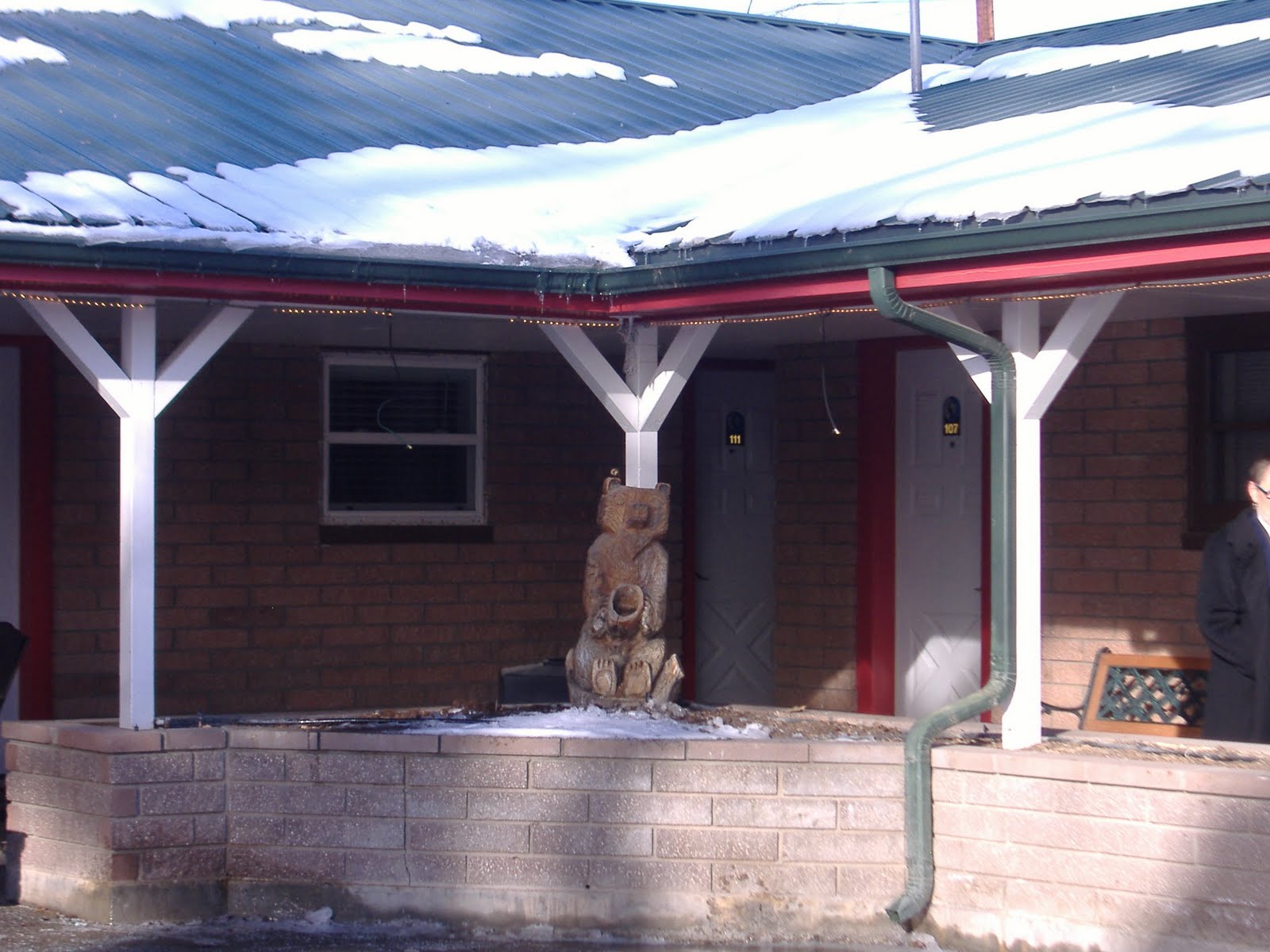
Some of Darrell's cousins who stayed at the same motel. Neil Lamont (Uncle Art's step-son and) Sylva"s husband (Aunt Thelma's daughter), Dave, Neil's son-in-law, and Marcel.Fun little place!

Uncle Scott's funeral program. Wish I knew how to flip it!

Trip to Ohio to visit Rob and Karen and Family, December 27, 2010-January 1, 2011

We flew to Ohio on Monday, December 26th, arriving at the Columbus Airport in the early evening. Rob picked us up and took us to his home where Karen had a delicious roast beef dinner for us! We enjoyed many fun activities while we stayed in Lancaster. One day, rob and Karen took us to Ash Cave. It is a land feature where the river has carved out a deep area and left cliffs above and caves under them. Large groups of people could stand under the overhang and be protected from inclement weather, but it is not enclosed. Icicles drip from above, forming beautiful water features at the falls and elsewhere. On one spot where icicles drip, the ice forms on the ground and grows up during the winter. I took a video of this water feature, but for some reason, it will not show up on this blog. The ice feature has grown to about 12-f15 feet and about the same circumference, looking like a huge snowman or a buddha. It was an interesting hike and well worth the short amount of time it took to reach the end where the largest cave and the largest ice feature were.

One day we traveled to Columbus and toured the COSI (Columbus Science Museum). We enjoyed the 3 d movie about building airplanes and jets, experienced the tv weather station area, watched fun experiments with electricity where Jonathan was the guinea pig volunteer, and saw kids unicycling 20o feet up on a wire. Jonathan was in line but it took too long, so he didn't end up doing it.

Darrell and Rob spent a lot of time together making repairs on Rob's home. I taught Jonathan how to count to 10 in Japanese and shopped with Karen and the girls for material for skirts for them. Karen treated us to delicious food, Navajo bread with sausage, eggs, fresh vegetables and cheese for breakfast and the most delicious apple cobble ever made!

That evening we ate dinner at Schmidt's Restaurant, a German place. The sausages were delicious as well as the hot potato salad, sauerkraut, and other yummy things. We enjoyed listening to the tuba, and the accordion with the accordion player singing German drinking songs. "In Munchen in dem trinken Haus, Einz, Zwei, Gesuffa!"

We all spent New Year's Eve at Kent and Georgia Emmers' home, eating homemade pizza and salad, and playing Apples to Apples. Kevin and his children, Mickell, and Tia, were there, as well as Jared, Kim and Mike and their son, Kaleb, and of course, rob, Karen, Jacob, Jonathan, Rachel, Kayleigh and Darrell and I.

We flew home on Saturday January 1st. It was a flight we will never forget. It took three legs to get home instead of the usual two. Columbus to Minneapolis to St. Louis to Salt Lake City. And instead of 6 hours, it was 10-12. At least we did get home in one piece! AND,we had a great time with Rob and Karen's family!

Family photos at Norco Park November 2010.

Brittany, Darrell, Brianna, Braden, Sheri, with Bailey, Stu with Bridgette.Brittany, Darrell, Brianna, Braden, Deb with Bailey, Stu with Bridgette.
Deb taught Brianna some basketball skills, and Darrell and Stu taught Braden some throwing horseshoe skills. we all enjoyed being outdoors and tried to get out full stomachs to rest. This was the day after Thanksgiving.

More photos of trip to Deb's November 2010


Deb planned a fun outing to Norco Park. Norco is a horse town. In fact, two riders were there at the park when we arrived. They let us pet their horses. Darrell and Stu played horseshoes, then Braden and Brittany, then Deb and I. We enjoyed the outdoors and playing this fun game.Brittany playing horseshoes at Norco park
Bridgette poses at Norco Park.
Brianna at Norco Park.
Braden tosses a horseshoe. He's a natural!